
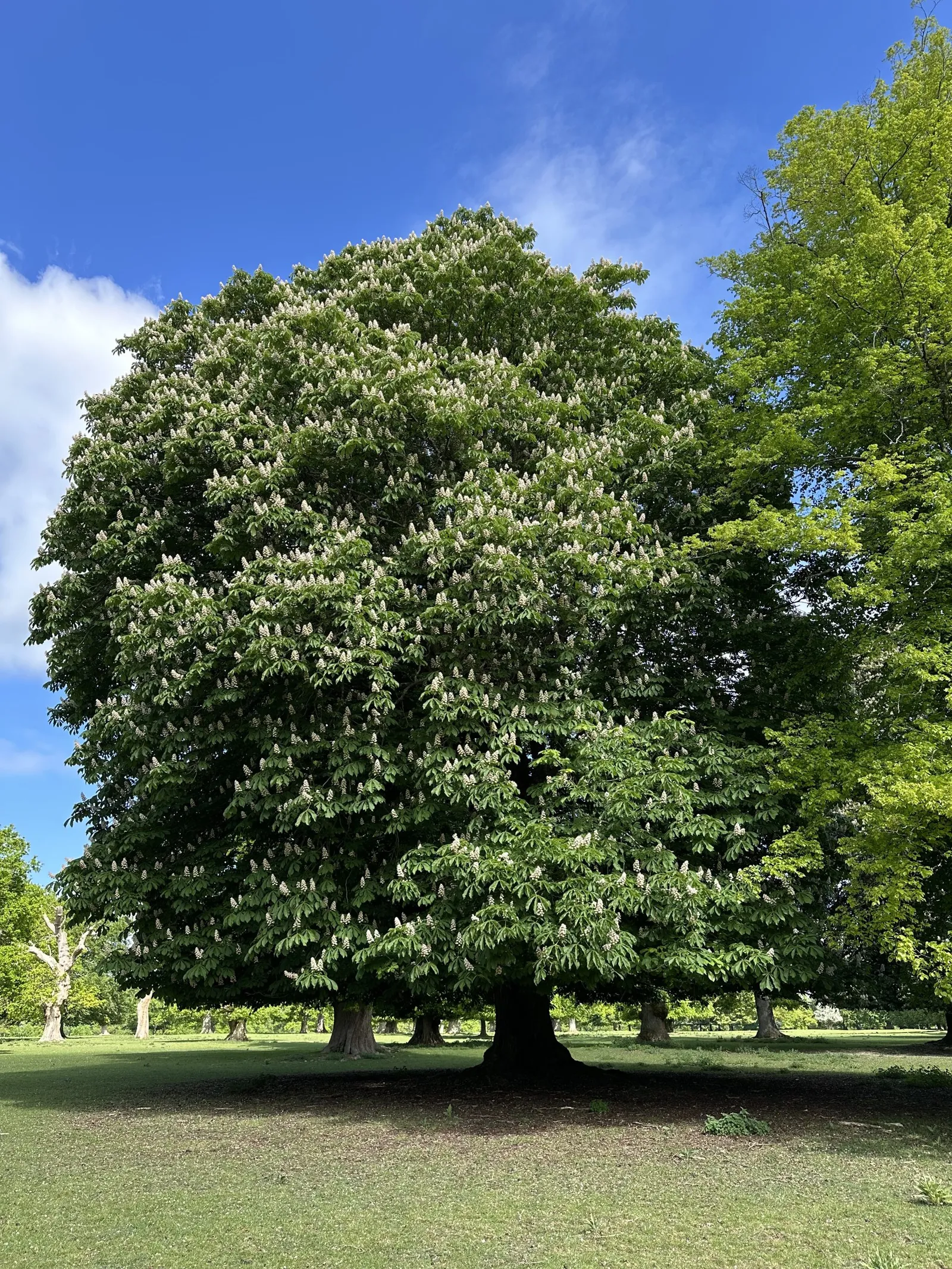
24 Aug Horse Chestnut
Horse Chestnut (Aesculus hippocastanum)
One of Britain’s most familiar and well-loved trees, for many the horse chestnut is the tree of childhood. It’s the tree that drops glossy brown conkers in autumn, shades village greens in summer, and signals the arrival of spring with towering white flower spikes. Yet despite its place in the British landscape, it isn’t native. It is an adopted favourite, one that has become woven into our parks, gardens and memories over the last four centuries.
Native to the mountainous forests of the Balkan Peninsula, particularly parts of modern-day Greece, Albania and North Macedonia, it was introduced to western Europe during the sixteenth century and reached Britain in the early 1600s, quickly becoming popular in the grand gardens and estates of the period.
Its scientific name, Aesculus hippocastanum, reflects an old belief that the seeds could be used to treat respiratory ailments in horses, hence the common name “horse chestnut.” Despite their resemblance to sweet chestnuts, the seeds are not edible for humans. Its timber is relatively soft and not especially durable, but its impressive size and broad canopy have made it one of Europe’s most popular park and avenue trees.
The horse chestnut is, of course, forever linked with the traditional game of conkers. Since the mid-nineteenth century, children have threaded conkers onto string and competed to see whose seed can withstand repeated blows. Although the exact origins of the game remain uncertain, it has become one of Britain’s most cherished autumn traditions.
In earlier times conkers were often carried in pockets to ward off rheumatism or hung in homes to deter spiders – beliefs that persist in some households today, even if science remains unconvinced.
Appearance and Identification
The horse chestnut is a large, imposing deciduous tree, typically growing to 25–35 metres tall, with a broad, rounded crown that casts deep shade beneath its branches. Its bark is smooth and pinky-grey in young trees, gradually developing a rough, scaly texture with irregular fissures as the tree matures.

Horse chestnut bark
Its leaves are among the easiest to recognise. Each is made up of five to seven large leaflets radiating from a central point like the fingers of an open hand. Fresh green and slightly glossy in spring, they create a dense canopy through summer before turning warm shades of yellow and gold in autumn.

Horse chestnut leaves
In May, upright clusters – often called ‘candles’ – rise above the foliage, each producing 20-50 white flowers marked with yellow and pink blotches. As the flowers are pollinated, these markings deepen to red, signalling to bees that nectar has already been collected.

Horse chestnut flowers
By late summer, the flowers give way to the tree’s most famous feature – the green, spiny seed cases which split open in autumn to reveal the polished brown conkers inside. Smooth, rich mahogany in colour and topped with a pale scar, they have fascinated generations of children and wildlife alike.
In winter, the horse chestnut remains distinctive thanks to its large, sticky buds, coated in a glossy resin that protects the developing leaves and flowers from cold weather.
Propagation and Control
The horse chestnut appreciates room to grow, and given enough space it can survive for well over two centuries. It prefers fertile, moist but well-drained soils – it struggles with prolonged drought, compacted soils and the increasing summer heat that we are experiencing more frequently.
Other challenges include horse chestnut leaf miner, a tiny moth which has spread across much of Europe. Its larvae tunnel through the leaves causing them to brown prematurely, weakening the tree’s resilience.
Source and Reference Materials
Information detailed in this post has been obtained from the author’s own knowledge and photographic library where possible. Additional source of information and photographs include:
Van den Berk, B.V. (2004). Van den Berk on Trees. Van den Berk Nurseries